Showing posts with label feng shui. Show all posts

Wednesday, May 11, 2016

Why is Feng Shui considered a science?


The science of Feng Shui remains squarely rooted in architecture, astronomy, physics, and design. According to the ancient "keepers of the knowledge" from the Taoist tradition, the evolutionary roots of Chinese Wholistic Medicine came into being at least  8,000 years ago through the first two of the Eight Branches of the Tao Healing Arts. Over the centuries the other six branches evolved into a unified way of life.

Feng shui is one of the Five Arts of Chinese Metaphysics, classified as physiognomy (observation of appearances through formulas and calculations). The feng shui practice discusses architecture in metaphoric terms of "invisible forces" that bind the universe, earth, and humanity together, known as qi/chi. 

Historically, Feng Shui was widely used to orient buildings—often spiritually significant structures such as tombs, but also dwellings and other structures—in an auspicious manner. Depending on the particular style of feng shui being used, an auspicious site could be determined by reference to local features such as bodies of water, stars, or a compass.
Qi rides the wind and scatters, but is retained when encountering water.[1]
Feng shui was suppressed in mainland China during the cultural revolution in the 1960s, but since then has increased in popularity.

"Physician, heal thyself."

Science is definited as follows:
  1. The observation, identification, description, experimental investigation, and theoretical explanation of phenomena. b. Such activities restricted to a class of natural phenomena. c. Such activities applied to an object of inquiry or study.
  2. Methodological activity, discipline, or study: “I’ve got packing a suitcase down to a science.”
  3. An activity that appears to require study and method: the science of purchasing.
  4. Knowledge, especially that gained through experience.
Feng Shui uses observation, repeatable calculations and methodologies, and is based on the study of the environment around, both inside and out. Kan Yu, the original name for Feng Shui, means “Raise the head and observe the sky above. Lower the head and observe the environment around us.” More precisely, Feng Shui is the scientific study of the natural and built environment. All in all, it is the study of environmental effects on people.

Just as acupuncture was not accepted by western medicine until several years ago, the study of Feng Shui is just now becoming popular. While there are many variations of Feng Shui that would not withstand the scrutiny of common sense, traditional Feng Shui has logical explanations for all of its methodologies.

Saturday, August 18, 2012

Pumping up your health


In Feng Shui, your Family & Health area is in the East. Green is the color of this quadrant, and the element is Wood. If you really want to pump things up, add the color green, and live plants. I painted my home office the color above, which is Benjamin Moore "Bunker Hill Green". The name of the color is just as important as the color itself. Bunker Hill is in Boston, my hometown. Since I live in California now, it gives me a little piece of home to have an "East Coast color" in my house. 

You should also be mindful of what is going on in the East quadrant of your house. If you have a fireplace, fire burns wood (the element of Health), so you are figuratively "burning your health". The cure? Add water. Water nourishes wood. So, adding fountains on either side of your fireplace would help. So would painting the room blue, which occurs as water in Feng Shui.

If you have dead plants in your Health area, I probably don't have to tell you this is not ideal. An abundance of the color red is also inadvisable. Red is fire, and fire burns wood. These details may sound strange, but they all add up to the overall feeling of balance in your home. 

Saturday, May 26, 2012

How to Get Floor Plans of Your House

Victorian House Plan

Courtesy of William A. Swan, eHow Contributing Writer
There are many times when someone who purchased an existing house will want to do renovations to it, and having the floor plans can help when making repairs or doing new construction. Unfortunately, these floor plans are often not available. But, with some time and effort, you can locate or recreate the floor plan for your house.

Instructions
  1. Locate the archives of the municipality or county where your house is located. The tax office usually has an archive section. If not, employees of the tax office might be able to help you locate the person in charge of the archives. The archives will have information about the original deed, owner, building permits and possibly a set of blueprints. If the floor plan is not there, proceed to the next step.

  2. Locate the fire insurance maps for the community. You can also find these at your local city or town hall. Many of these maps date back to the late 1800s. The maps can indicate the construction material used and include a three-dimensional drawing of the neighborhood in which your home is located. With these, you could determine the frame of the structure and where old windows or doorways were. If you need more help, proceed to the next step.

  3. Find your local building inspector's office. If it is not in the city or town hall, the clerks should be able to tell you where to find the building inspector. Builders usually apply for a permit before building houses. Permits, along with floor plans and elevation levels, are located at the building inspector's office. While these permits might not be as old as your house, they can give you details about the floor plan up to the last 20 years. If you still need more detail, continue down the list.

  4. Browse through historical plan books. These are useful if the house was built in the early 20th century. Many homes built during that time period started from floor plans or kits bought from stock plan books or Sears, Roebuck mail-order kits. The next step provides more information about this.

  5. During the latter part of the 20th century, many floor plans and home designs were advertisements in newspapers and home magazines. You can find many of these home plans through library archives or the Internet. This type of advertising was common from the '70s through the mid '90s.

  6. Speak with neighbors. Often, if you look around your neighborhood, you will notice that your house is similar to others in the area. Someone with a similar house design might have a floor plan or information on where to get one. Levittown, New York and sections of Amityville, New York are good examples of this. If this does not work, you still have one more step to try.

  7. Hire an expert in the housing industry. The person will most often be an architect or structural engineer who can use a set of field measurements and other clues to recreate a floor plan for your house.
Good Luck!

Tuesday, February 14, 2012

Feng Shui alters Bay Area city's rules for addresses


Developers worry residences' digits may clash with ancient beliefs about good and bad luck.

By The Associated Press, Found on democraticunderground.com

HAYWARD, CA -- Developers looking to maximize the marketability of their homes are complaining about the city's street address rules, which they say can scare off buyers who practice the ancient Chinese art of feng shui.

Under a numbering system established by Alameda County in the 1950s, addresses are assigned based on how far the homes are from downtown Oakland, a method that puts five digits on almost every mailbox in Hayward and other cities in the county. Home builders recently raised concerns that they may decrease property values because the odds are greater that an address will carry a number considered unlucky by feng shui practitioners.

City Council members voted unanimously last week to allow the builders of an upscale development to use shorter street numbers. In seeking the waiver, the builders cited convenience concerns as well as the potential for violating feng shui precepts, according to Richard Patenaude, a Hayward city planner.

Sunday, December 25, 2011

What's all this fuss about Money Frogs?

You may have heard about the Feng Shui Money Frog - a strange creature that is supposed to bring great riches to its owner. But why? And how?

Read a testimonial from one of my clients after installing a Money Frog at his office.

The History


To the Chinese, the frog symbolizes the moon - "the lunar, yin principle" and brings healing and prosperity.

The Feng Shui Money Frog is called "Chan Chu" in China (literally "wealth-beckoning toad").

Traditionally, it is depicted holding a Ching Dynasty coin in its mouth and sitting on piles of gold ingots, coins and wealth.

On the back of the King Chan Chu are 7 diamond dots depicting the Ursa Major. The study of Chinese Elemental Astrology is based on the 7 stars, which, when coupled with 2 hidden supporting stars represent the 9 Stars of the Bagua, which is the basis for all study on Feng Shui.

The Bagua also protects against loss of the money gained.

Another type of Money Frog carries a string of chinese coins tied behind its back. The Chinese believe this frog is a symbol of your cash flow, so of course the bigger the frog the bigger the cash flow.

The Legends

One legend says that the Money Frog exists on the moon. When there is an eclipse, the frog appears to swallow the moon.

Chang NgoAnother legend claims that the Money Frog was originally Chang Ngo, the wife of a legendary figure. She was greedy, and stole the Elixir of Immortality from Goddess of the West (Hsi Wang Mu).

The other deities in heaven punished Chang Ngo for this, by transforming her into a three legged frog and banishing her to the moon. Now whenever people see the Money Frog, there is a bed of money surrounding it because Chang Ngo is naturally greedy. For generations, this mythical frog has been the holy creature that protects against misfortune and promises to bring riches and wealth to the household.
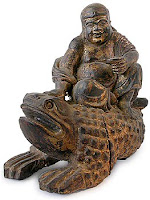
Lui HaiAlso related is Lui Hai, one of the 8 Immortals. He was a Minister of State who lived during the Tenth Century.

Lu Hai knew of the frog's fondness for money, so he used bait (a red line tied with gold coins) to lure the frog from hiding. Because of this, it has become popular that a frog with coins symbolizes that wealth is about to come and greet you.

Read all about the History of Feng Shui at Feng Shui Style.


Types of Money Frogs:

Jade and precious stones

Jade Money FrogReal jade Money Frogs are excellent, because they literally ARE precious, and are said to offer protection to businesses.

Send us an email at jennifer@fengshuistyle.us to inquire about Jade Money Frogs. They are only available at one place in Chinatown. We have an exclusive arrangement with the owner, and this is where we get all of our Jade Money Frogs.

We can get you any size you like. They range from $125 to $3000, depending on size.

Rosewood Resin (Red)


Red frogs are the most "Yang", so they activate the wealth energy. This particular frog comes with a porcelain dish filled with loose sodalite crystals. Crystals are famed as energy cleansers and will provide a positively-charged environment. Both of these items should be placed together in the appropriate areas of the home and office for the best Feng Shui.

Gold or Bronze

These frogs are said to appear every full moon, bringing good news and wealth to the people nearby. Gold is considered one of the symbols of wealth so for greater luck and energy, place at least one money frog on a bowl full of golden coins.

Gold Money Frog
Where to Place your Money Frogs:

One of the most auspicious places is inside, in the wealth area (Southeast) and across from the front door on a diagonal.

This allows the frog to view the front door. It is important for the frog to have the coin in its mouth with the good luck symbol facing up. You can glue the coin in so it does not fall out or get lost. The coin should also be facing the front door; it is as if the frog is saying, "I will catch all your money here ... bring it on!"

To learn about how to pump up all the areas of your life, go to Feng Shui Style.

Important: Some people believe you should turn your money frog around at night, to face inward. This is said to "keep" the money that you accumulate.

How many frogs should I get and what size?

For an average size room or office select a frog about three inches high and three inches wide. Larger frogs are fine for larger spaces - buy the biggest one you can afford.

You can use as many as 9 money frogs (the number of completion), but if you do they should be smaller frogs.

You can place them everywhere except the kitchen, bathroom and bedroom.
  • You may place Money Frogs in your living room area or where you conduct business.
  • You may place a frog in each corner of your Bagua.
  • They should not be immediately obvious to visitors.
  • They should not be on the ground, up too high, or above the height of the pockets of people coming into your home or office.
  • No one should enter feeling as though you want their money.

When using Money Frog cures it is important to check in with yourself and see if this does indeed create a feeling of wealth for you and see if you have a personal connection to your Money Frog.

Before I studied Feng Shui I intellectually "got" what the Money Frog meant but I felt the cures did not work as well because I didn’t have a sincere appreciation for the background and legend of the frog. After I completed my Feng Shui study, I understood the Money Frog on a cellular level, and now they work brilliantly for me.

Get a Feng Shui Consultation today for your home or office at Feng Shui Style.

Tuesday, October 18, 2011

Hot Feng Shui Tips


  • For maximum curb appeal, plant some colorful flowers, especially red ones.
  • Make sure to fix anything that is broken or dirty.
  • An imaginative paint job is another way to play up your house. If you are lucky enough to have interesting architectural details, use different coordinating colors to maximize the effect.
  • In China, red is supremely powerful. It represents relationships, fame, reputation, and wealth.
  • It’s also a fabulous color to paint your door. Guests will be able to find the door quickly and easily. It also conveys that the owners are powerful, and even thwarts burglary!


  • Go for S-P-A-C-E by clearing out EVERY unnecessary item from your home. 
  • The definition of clutter is something that you have not used for 18 months or so, but you are hanging on to, just in case it comes in handy
  • When buying a new home or office, look for a regular shaped property. Avoid properties that have odd looking shapes. The best shape is a rectangle or square. If there are a few extensions sticking out, don’t worry too much as they can be easily rectified.
  • Keep your porch and outside lights on at night! Make sure people can see your house numbers - make them large!
To get a full-blown Feng Shui Consultation, visit our website, Feng Shui Style.

Friday, August 19, 2011

What are the oldest forms of Feng Shui?


The oldest form of Feng Shui, the Form School has to do with the shapes and forms of the surrounding landscape and waterways and how they affect people living or working in a structure. The four cardinal compass directions are represented by four animals: The Green Dragon of the East, the White Tiger of the West, the Red Phoenix of the South and the Black Turtle of the North, referring to the ideal landforms to look for around the outside of your home. Gentle hills at the back of the house offer protection. These are called “Black Turtle”.

The “White Tiger” hill to the West of the house also gives protection (this side should be a bit lower than the opposite East side). The “Green Dragon” hills to the East of the house bring abundance and prosperity – these two landforms should ideally be low hills, other buildings, trees etc. Finally, most importantly, the “Red Phoenix” or “little footstool” (a tiny hill) in the front of the house needs open space to prosper. It represents your opportunities and financial affairs. The 4 celestial animals are also used inside the house for furniture placement, office interior designs, etc.

To get a full-blown Feng Shui Consultation, or read all about the history of Feng Shui, visit our website, Feng Shui Style.

Friday, July 17, 2009

Feng Shui revival defies prohibition in China


(Xinhua) Updated: 2006-08-31 22:57

BEIJING -- Feng Shui is gaining popularity in China's affluent coastal cities including Guangzhou, Shanghai and Shenzhen, although it is still illegal. Many Feng Shui masters have established consultancy firms, offering advice on issues such as career, marriage, health, debt, investment, study and names according to Feng Shui principles. More than 1,000 Feng Shui guides work in agencies in Shanghai, according to Wang Xiaohe, manager of a Shanghai-based Feng Shui company.

"Feng Shui is widely applied in interior decorating and real estate, so it has attracted many estate agents and entrepreneurs," says Wang. Feng Shui is the ancient practice derived from the ideas in the Book of Changes, an ancient Chinese divination and philosophical manual.
It involves ensuring a good flow of energy, or qi. Buildings and other structures need to face certain directions depending on their surroundings. Elements such as wood, fire and earth have to be carefully balanced. It is necessary to avoid random and haphazard arrangements of furniture and accessories according to Feng Shui guides. Wang says many entrepreneurs will consult on the future of their businesses, while estate agents are more likely to consult on the position of furniture and the environment of their projects.


Consultants usually charge 30 yuan (US$3.75) per square meter for property advice and 300 yuan (US$37.5) per half hour for other services. Advice on the name of a person or a company can cost from 800 to 1,800 yuan (US$225), Wang said, adding prices are negotiable according to the customer's means. The influx of residents from Hong Kong, Macao and Taiwan, where Feng Shui is legal and commonly used, has contributed to its popularity, says Zhang Zhizhe, chairman of the Shanghai Yi Jing Institute.

"My company is small, but we have long-term clients and have already made a lot of money," says Li Xiuxia, manager of another Shanghai-based consultancy, adding it planned to advertise to attract more customers. The Yi Jing Institute is trying to list Feng Shui as a world intangible cultural heritage, but as long as it remains illegal, this could prove to be difficult.

"Feng Shui guides usually start out as consultancy companies, otherwise the administrations of industry and commerce would prohibit them from operating as the public practice of Feng Shui is illegal," says Zhang.

Professor Yu Wujin, of Fudan University philosophy department, says, "They change the name from 'Feng Shui' to 'consultant' to avoid being considered 'superstitious' by the public, but it also suggests a wider and more modern definition of 'Feng Shui'." Yu believes the consultants are exploiting modern anxieties in a competitive society. "In a market economy, people wish to lower the risk of failure and danger in their lives and work and turn to the Feng Shui masters for help."

The practice of Feng Shui was made illegal after the founding of the People's Republic of China in 1949 as the new government determined to eliminate the "four olds", namely the old ideas, old culture, old customs and old habits. The Shanghai Administration of Industry and Commerce could give no numbers or identities of consultant companies involved in Feng Shui practice, but said their businesses were legal in terms of the registration procedure. Feng Shui is a part of China's traditional culture, which has never really died out, says Zhang Zhizhe. "Feng Shui guides solve modern problems in a traditional way."

To get a free estimate on a full-blown Feng Shui Consultation, visit our website, Feng Shui Style.

Tuesday, March 10, 2009

The History of Feng Shui

Introduction

Lo Shu TurtleOriginating in China almost 6,000 years ago, Feng Shui literally means "wind"(Feng) and "water"(Shui). Feng Shui is also referred to as "Geo-mancy" or "Earth Wisdom".

It is an ancient method of constructing and optimizing residences to bring about happiness, abundance and harmony. It includes architecture, urban planning, interior design, garden design, and placement of objects in our environment. It also involves the layout, framework, materials and colors of building structures. These rules of thumb allow us to make the most ideal arrangement in any given situation.


In ancient China, farms and villages were auspiciously placed within the protective folds of mountains, shielded from harmful winds and nurtured by the gentle, winding streams. The people who practiced these principles prospered in agriculture and trade and grew strong and powerful. They produced social, cultural and military leaders unlike their neighbors who were exposed to harsh winds and inhospitable terrain. The art of Feng Shui was refined over many centuries, producing an abundance of learned scholars.

Traditionally, Feng Shui was considered a highly guarded secret of the Chinese Imperial Court. All Feng Shui Masters were forbidden to release their potentially powerful knowledge to outsiders. The practice of Feng Shui was considered so powerful that it would be devastating in the hands of the enemy. Consequently, knowledge was handed down from father to son within family traditions. The turbulent history of China has only helped to reinforce this tendency and this secrecy often continues, even today.

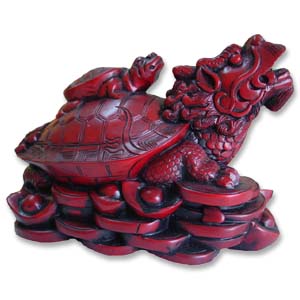
The Lo Shu Turtle has been said to bring eight different types of heavenly blessings but it is very attuned towards bringing wealth luck. When it is depicted with a baby as it is shown here, it is said to be especially powerful.

To get a free estimate on a full-blown Feng Shui Consultation, visit our website, Feng Shui Style